
ITIL 4 vs ITIL 5: What’s Really Changed — And Why It Matters in 2026.. AI of course..
January, for many, is the new year ramp-up. The Christmas festivities are over, the wrapping paper has been binned, gym owners rub their hands with glee at the new attendees looking to lose a few pounds, and businesses refocus for the year ahead.
With the horizon of the new year in view. Sharing my second article for 2026.
As the pace of digital transformation accelerates, IT Service Management frameworks must evolve to keep organisations aligned with rapid technological, operational, and customer‑experience expectations.
With the release of ITIL 5 in January 2026, the ITIL community receives not a replacement for ITIL 4, but a significant evolution designed for an AI‑enabled, digital‑first world.
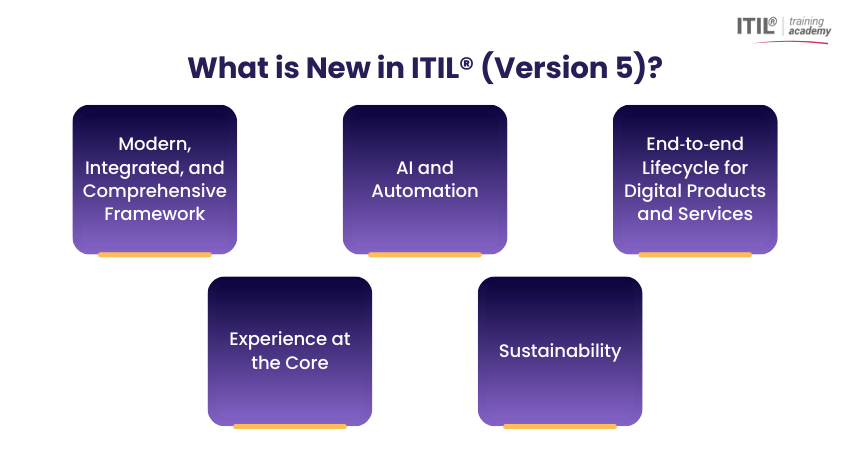
The official snapshot of the changes from ITIL 4 and here we are with ITIL 5
Here’s a clear breakdown of how ITIL 5 differs from ITIL 4, and why these changes matter.
1. Mindset Shift: From Service Value to Digital Product + Service Management
ITIL 4 introduced the Service Value System (SVS) and value‑stream thinking. ITIL 5 goes further by explicitly shifting to Digital Product and Service Management, treating products and services as two sides of the same lifecycle.
This unified lifecycle allows organisations to design, build, launch, operate, and improve as a single flow—reducing gaps, improving value delivery, and aligning IT with business outcomes.
2. AI‑Native by Design
While ITIL 4 acknowledged the emerging role of automation and AI, ITIL 5 fully embraces it. The new version includes:
Explicit AI governance guidance
Operating models built for AI‑driven decision‑making
Practical adoption support for AI‑enabled workflows
This makes ITIL 5 the first truly AI‑native service management framework.
3. Practical, Outcome‑Focused Guidance
ITIL 4 modernised ITSM, but adoption often required interpretation. ITIL 5 provides more practical, role‑aligned guidance, offering clarity for product managers, service owners, engineers, operations teams, and leadership.
This helps accelerate real‑world adoption and reduce ambiguity.
4. Stronger Emphasis on Customer and User Experience
ITIL 4 introduced co‑creation of value, but ITIL 5 makes experience a central pillar.
User experience
Transparency
Measurable value
Continuous feedback loops
This aligns ITIL 5 with today’s digital‑product operating models that prioritise journeys...
...not just processes.
5. Broader Organisational Scope
ITIL 4 expanded beyond IT. ITIL 5 takes this even further, positioning the framework as guidance for enterprise‑wide digital operations, not just ITSM.
The message is clear:
ITIL is no longer just for IT—it’s for everyone contributing to value delivery.
6. What Stays the Same?
ITIL 5 preserves many of the foundational components of ITIL 4:
The Guiding Principles
The Four Dimensions of Service Management
The Service Value System (SVS)
All 34 practices, with only minor terminology updates
This ensures continuity and protects the investments organisations have already made.
7. Backward Compatibility & Evolution, Not Disruption
The shift from ITIL 4 to ITIL 5 is intentionally non‑disruptive. Existing:
Certifications
Knowledge
Processes
Investments
…remain valid and directly applicable. ITIL 5 builds on them rather than replacing them.
Final Thoughts
ITIL 5 arrives at a critical moment—when organisations must scale digital operations, integrate AI responsibly, and deliver seamless product‑service experiences. ITIL 4 laid the foundation; ITIL 5 builds the modern, AI‑ready, end‑to‑end operating framework organisations now need.
For IT leaders, the message is reassuring: ✨ Everything you know still matters—ITIL just got smarter, more practical, and more future‑proof.
#ITIL5 #ITIL4 #ITServiceManagement #DigitalTransformation #AIOps #ProductManagement #ServiceManagement #EnterpriseServiceManagement #ITGovernance #DigitalProducts #CustomerExperience #Automation #ValueDelivery #TechLeadership #ITFrameworks #ProfessionalDevelopment
