
Max Headroom, Memory, and the Uncanny Valley We’re Already Living In - An Article
In 1985, I won a Welsh-language poetry prize at the Ysgol Pantycelyn school eisteddfod under the pen name Max Headroom. At the time, it felt mischievous — a slightly surreal alias lifted from a strange, glitchy TV character from S4C/Channel 4 who seemed to be beamed in from the future.
Years later, in 1992, I found myself studying at an institution whose alumni included Rocky Morton and Annabel Jankel — the creators of Max himself. I am very proud of my time at the then Surrey Institute of Art and Design. Subsequently, Surrey University for the Creative Arts.
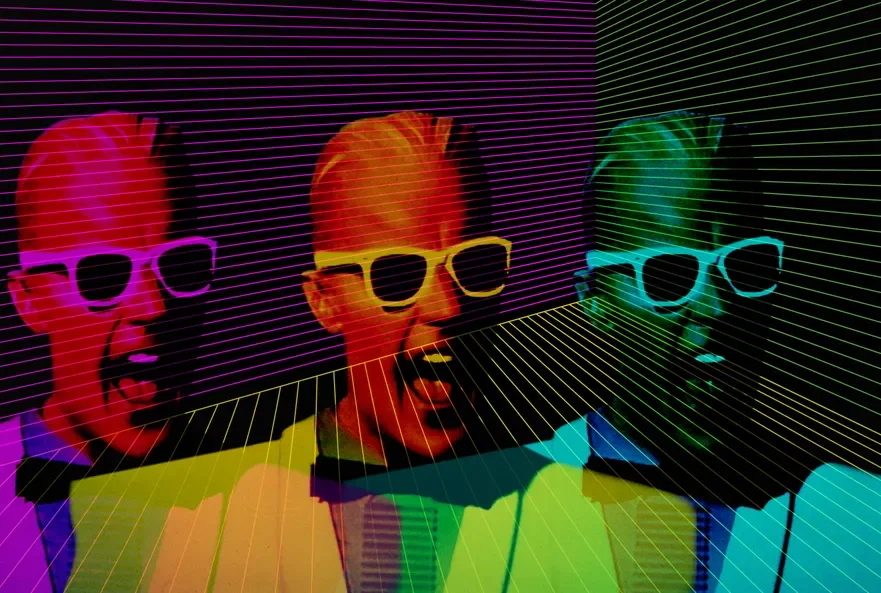
Matt Frewer as Max Headroom
That odd personal loop has stayed with me ever since, especially now, as we find ourselves living in a moment that feels eerily close to the world the show imagined.
Because Max Headroom wasn’t just a gimmick, he was a question.
A question about identity. A question about media. And, most importantly, a question about what happens when technology begins to simulate the human voice.
The Original Idea Was Far Ahead of Its Time
In the Max Headroom universe, a journalist named Edison Carter suffers an accident. His memories are uploaded, and from them emerges Max — a glitchy, sarcastic, synthetic echo of a human consciousness.
Not a robot. Not quite a person. Something in between.
In the 1980s, this was speculative fiction.
Today, it reads less like sci-fi and more like a product roadmap.
We now have:
Synthetic voices are indistinguishable from real people
AI presenters reading the news
Digital avatars hosting events
Models trained on decades of human media
The “uncanny valley” Max embodied is no longer theoretical — it’s commercial.
The Risks We’re Facing Now:
The parallels to today’s media landscape are uncomfortably strong.
Synthetic Authority
AI presenters can look and sound credible without possessing understanding. The risk isn’t just misinformation — it’s believable misinformation delivered with confidence.
Identity Drift
If a digital persona can be trained on a real individual’s voice, style, or archive, where does authorship end? At what point does a persona stop being homage and start becoming appropriation?
Emotional Manipulation at Scale
Max Headroom’s world imagined media monopolies manipulating audiences through technology. Replace broadcast networks with algorithmic feeds, and the scenario feels less fictional.
Truth Fragmentation
When every voice can be cloned, and every image generated, trust becomes the scarcest resource in the information economy.
We are not just entering the uncanny valley. We are building infrastructure inside it.
What Max Headroom Got Right
Looking back, the creators weren’t predicting hardware — they were predicting behaviour.
Three lessons stand out:
Media Power Centralises First, Democratises Later.
New technology tends to be controlled by a few before it becomes widely accessible. We are still in that early consolidation phase with generative AI.
Authenticity Becomes Premium
In a world of perfect simulation, imperfection becomes valuable. Human nuance — hesitation, fallibility, lived experience — becomes a differentiator.
The Real Risk Is Cultural, Not Technical
The show wasn’t really about AI. It was about what happens when society stops questioning the medium.
That feels highly relevant now.
Are We Close to a Real “Digital Host”?
Short answer: closer than many realise — but not in the way fiction portrayed.
We already have:
AI newsreaders operating 24/7 in some regions
Virtual influencers with millions of followers
Synthetic podcast hosts
Corporate AI spokespeople
In narrow contexts, digital hosts absolutely exist.
But there’s a distinction worth making:
We have simulation, not sentience.
Today’s systems can convincingly emulate personality, but they do not possess continuity of self — the defining trait of a real consciousness.
There is no Edison Carter behind the curtain.
At least, not yet.
The Neural Interface Wildcard
What makes this moment particularly interesting is the work underway on brain–computer interfaces. Companies like Elon Musk’s Neuralink are exploring ways to read neural signals directly and, in time, potentially write information back into the brain.
Today, the applications are primarily medical — restoring movement, enabling communication, repairing neurological damage — and the progress there is genuinely remarkable.
But conceptually, this is the first credible step toward something Max Headroom imagined: capturing not just a voice or style, but elements of cognition itself. If neural patterns can be recorded, modelled, and reconstructed, the line between training an AI on someone and preserving a digital continuity of someone begins to blur.
We are nowhere near “uploading a soul,” but the philosophical shift is profound:
Max Headroom stops looking like satire and starts looking like a distant, unsettling edge case on a very real technological spectrum.
Have We Arrived in the World of Max Headroom?
In tone and texture — yes. In philosophy, partially. In existential terms — not quite.
We are living in a proto–Max Headroom era.
The aesthetics are here: glitches, avatars, synthetic personalities. The media disruption is here: trust erosion, blurred reality. The commercialisation is certainly here.
What isn’t here is true digital personhood.
But the trajectory is undeniable.
The Real Question for Leaders
The question isn’t whether we will build increasingly convincing digital hosts. We will.
The real question is whether we build:
Governance alongside capability
Ethics alongside innovation
Transparency alongside scale
Because the future won’t be shaped by the most powerful models...
It will be shaped by the most trusted ones.
A Personal Reflection
As someone who once hid behind the name Max Headroom for a bit of youthful mischief back in the 80's, it’s surreal to now see the world inch closer to the ideas that character embodied.
Back then, Max was a joke with a philosophical aftertaste. Now, he feels more like a warning wrapped in satire.
And perhaps that’s the lasting lesson:
The future rarely arrives as a dramatic reveal. It arrives gradually — until one day you realise you’ve been living in it for some time.
If Max Headroom taught us anything, it’s this:
Technology doesn’t just reshape media. It reshapes trust.
And trust is the one system we can’t afford to let glitch.
For now though.. Don't worry..
Have a listen to the classic The Art of Noise with Max Headroom - Paranoimia
https://www.youtube.com/watch?v=6epzmRZk6UU
(and yes, I always wanted a teasmaid)
#AI #ArtificialIntelligence #DigitalEthics #AITrust #SyntheticMedia #Leadership #DigitalTransformation #FutureOfWork #AIForGood #TrustInAI #MediaLiteracy #GenerativeAI #Innovation #AIThoughtLeadership #ElonMusk #Neuralink #MaxHeadroom #EdisonCarter #ArtOfNoise #Network23 #NetworkXXIII #SurreyInstituteOfArtAndDesign #UniversityForTheCreativeArts
