

The Adventure Game, Monkey, and Micro Live: When BBC2 Treated Its Viewers Like Thinkers
HAPPY BOXING DAY EVERYONE!
I hope you had the most marvelous Christmas Day, and with all the festive television, it reminded me of days past..
What we used to enjoy, and yes.. a time when we were encouraged to think on an early Friday evening.
There was a brief, glorious period in the early 1980s when BBC2’s early-evening schedule quietly assumed that its audience—young or old—was curious, imaginative, and intellectually game for a challenge. It was an era when television did not talk down, did not over-explain, and certainly did not fear bafflement.
At the heart of this philosophy sat one of the most singular programmes British television ever produced: The Adventure Game.
A Game Show From Another Planet (Quite Literally)
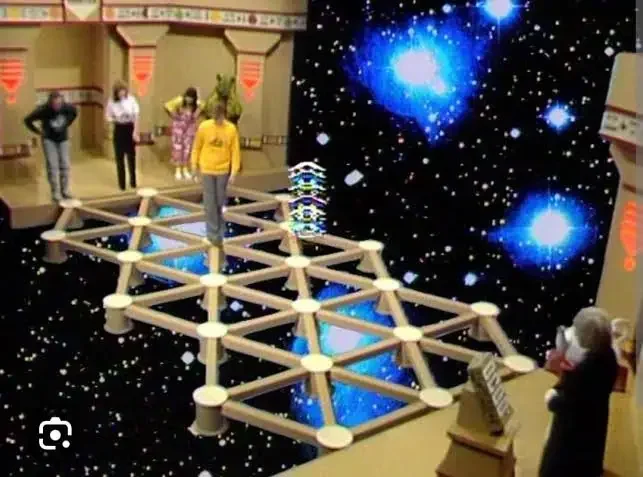
First broadcast in 1980, The Adventure Game was a science-fiction game show that felt like it had slipped through a crack in the BBC’s scheduling logic. Contestants—often academics, students, or professionals—were transported to the alien planet Arg, ruled by the inscrutable and mildly hostile Rangdo.
Hilariously, the Rangdo's conversation was stunted to usually just Gronda Gronda. Eventually, Rangdo evolved from a dragon-type creature to an Aspidistra. Yes, the plant was literally.. a plant.
If you are thinking that this sounds all very Douglas Adams, you would be absolutely spot on. This was very much the era of Adams's Doctor Who and the dawn of The Hitchhiker's Guide To The Galaxy.
Adams didn't create the series; that was Patrick Dowling, but his influence is significant.
Actually, Douglas Adams appeared on The Adventure Game in Series 2 (1981), during a period when the programme was at its most confident and conceptually daring. Appearing as a celebrity contestant, Douglas Adams was not merely a participant but an almost symbolic presence: a writer whose worldview aligned uncannily with the show’s fusion of rigorous logic and deadpan absurdity.
His performance exemplified the intellectual playfulness the series championed — thoughtful, amused, occasionally exasperated, and fully aware of the cosmic joke at work.
While Adams did not formally contribute to the writing or format of the series, his involvement retrospectively reinforced The Adventure Game’s cultural legitimacy as “serious nonsense”: television that trusted wit, curiosity, and intelligence over spectacle.
In hindsight, his appearance functions as a kind of cultural seal of approval — a moment where British science-fiction comedy and experimental factual entertainment briefly overlapped, affirming the programme’s place as a forerunner to later puzzle-based and escape-room-style entertainment, and as a rare example of television that assumed its audience could keep up… or at least enjoy failing intelligently.
Unlike conventional quiz shows, there were no buzzers, no points tallying, and no prizes of material value. Instead, contestants were asked to solve logic puzzles, physical challenges, and lateral-thinking problems to survive—and ultimately escape.
This was not accidental eccentricity. The show was deliberately designed to reward reasoning, collaboration, and calm thinking under pressure. It trusted its participants, and by extension its audience, to follow along without spoon-feeding explanations.
In doing so, it arguably laid down the conceptual foundations for what we now recognise as the modern escape room.

The Original Escape Room—Broadcast Weekly
Long before escape rooms became team-building staples and Friday-night diversions, The Adventure Game was already exploring the format’s core mechanics:
A confined environment
A set of abstract rules
Time-limited challenges
Success is dependent on communication and logic rather than strength or speed
Today’s escape rooms rely on immersive theming, cryptic clues, and shared problem-solving. The Adventure Game achieved the same effect with papier-mâché sets, dry wit, and an unwavering belief that thinking itself was entertaining television.
In many respects, it was decades ahead of its time.
Whilst the cast portrayed characters from far, far away.. One of them was the very corporeal and real Moira Stewart. Yes, that Moira Stewart from BBC News!
It spawned a whole series of iterations, including The Crystal Maze, Fort Boyard, Gladiators, Total Wipeout, Ninja Warrior.. All progressively increasing in their flamboyancy and action, but losing the intellectual and imaginative nuance.
Monkey: Dubbed Brilliance and Controlled Chaos
The show rarely stood alone. It was often scheduled alongside Monkey, the BBC’s dubbed version of the Japanese series Journey to the West.
Monkey was, and remains, essential viewing. Its surreal storytelling, anarchic humour, and martial-arts spectacle were made iconic in the UK by its English dub—featuring future legends such as Miriam Margolyes.
The result was something uniquely British: a serious mythological epic rendered both thrilling and unintentionally hilarious. It paired beautifully with The Adventure Game—one offering chaotic fantasy, the other structured cerebral challenge. Together, they trained a generation to embrace the strange, the foreign, and the intellectually demanding without fear.
Micro Live and the Dawn of Digital Literacy
Following this double act of imagination came Micro Live, the BBC’s weekly deep dive into computing.
This was not surface-level gadgetry. Micro Live treated computer literacy as a public good, with a particular focus on the BBC’s own BBC Micro. Programming, hardware, and digital futures were discussed openly and accessibly—without ever diluting the complexity of the subject.
For many viewers, this was their first exposure to computing not as magic, but as something understandable, learnable, and empowering.
The series was the flagship of The BBC Computer Literacy project, which I will write about in more detail in the future.
Series regulars included the avuncular Ian McNaught-Davis, former Blue Peter host Lesley Judd, then Fred Harris from Play School/Radio 4's The Burkiss Way and the subsequent TV iteration End Of Part One (Do yourself a favour and look this one up if only for his hilarious Jon Pertwee). From the United States, we finally had Connor Freff Cochran.
A Schedule With Confidence—and Courage
What united The Adventure Game, Monkey, and Micro Live was not genre, but intent. BBC2’s early-evening schedule at the time was unapologetically skewed toward the young intellectual viewer—curious minds who wanted to be challenged, amused, and occasionally bewildered.
This was television that assumed its audience could cope with ambiguity, foreign cultures, abstract logic, and emerging technology. It did not chase instant gratification. It cultivated patience, curiosity, and critical thinking.
And perhaps that is why we have not quite seen its like since.
A Quiet Legacy That Endures
Today’s escape rooms, STEM education initiatives, and even collaborative problem-solving video games owe a small but meaningful debt to The Adventure Game. Likewise, the mainstream acceptance of international television formats and early digital literacy can trace lines back to Monkey and Micro Live.
This was public service broadcasting at its most confident—witty, experimental, and slightly anarchic. It did not merely entertain; it invited viewers to think.
One cannot help but feel that modern television could benefit from remembering that audiences, when trusted, often rise to the occasion. Occasionally, they even enjoy being challenged—preferably by an alien who looks faintly annoyed at their presence.
The entire Adventure Game series is available on DVD, as is Monkey.
Micro Live is freely available on YouTube and highly recommended as a window on technology past.
I love watching it for sentences that start with 'In the future we will have.. ' and seeing if we delivered, and enjoying when predictions go terribly wrong. For my friends in the US, an alternative to Micro Live is the wonderful Computer Chronicles presented by Stewart Cheifet, but that is an article for another time.
Gronda Gronda
HAVE A MARVELLOUS CHRISTMAS WEEK, EVERYONE!
#TheAdventureGame #BBC2 #BritishTelevision #PublicServiceBroadcasting #EscapeRooms #STEMEducation #1980sTV #MonkeyMagic #BBCMicro #DigitalLiteracy #ThinkingTelevision #MediaHistory #TheComputerChronicles #douglasadams #HHGTTG #TheHitchHikersGuideToTheGalaxy
