

The Royal Institution Christmas Lectures: Britain’s Greatest Science Tradition (and the TED Talk of My Childhood)
December 20, 2025
Every year, as the nights draw in and the television schedules fill up with the familiar festive staples, there’s one tradition that has always felt different to me.
Not because it’s loud. Not because it’s drenched in tinsel. And certainly not because it involves celebrities skating, singing, or eating something with too many legs.
It’s different because it treats curiosity as something sacred.
I’m talking about the Royal Institution Christmas Lectures — a uniquely British institution that has quietly (and sometimes explosively) shaped how generations think about science, technology, nature, and the future. For me, it wasn’t just “a science programme”. It was an annual doorway into the big questions.
It was the TED Talk of my childhood — before TED Talks were even a thing.
A tradition born in 1825… and still going strong.. 200 years later..
The Christmas Lectures began in 1825, created at the Royal Institution in London with a clear mission: make science accessible, exciting, and meaningful to young audiences (and, thankfully, young-at-heart adults as well).
This wasn’t “science as homework”. It was science as theatre: real demonstrations, live experiments, and a genuine sense of wonder — all delivered by people who truly knew their subject.
The most legendary early figure is Michael Faraday, who didn’t just participate — he defined the standard. Faraday delivered 19 series, including the famous The Chemical History of a Candle, later published as a book and is still widely read today.
And that tells you something important: these lectures weren’t meant to be disposable TV.
They were designed to last.
How the lectures became British television’s most intellectual Christmas gift
Many people assume the Christmas Lectures first hit TV in the 1960s. That’s a great pub fact… but also wrong.
The Royal Institution notes that Christmas Lectures content was used in 1936 for some of the first scientific experiments broadcast on television, only weeks after the BBC began.
After a wartime suspension (the lecture series paused during WWII), TV collaboration returned — including broadcasts in 1949 and again in late 1949 — but the real turning point came in 1966, when the newly formed BBC Two commissioned a complete televised series, beginning regular annual TV transmission in the modern sense.
From there, the Christmas Lectures became something rare:
intellectually ambitious
designed for younger audiences
and still capable of captivating a whole household
In other words: a national treasure hiding in plain sight.
The secret formula: why it works (and keeps working)
A lot of programmes teach. The Christmas Lectures invite you in.
They succeed because they combine:
1) A young audience as the priority
Not “talking down” — but genuinely aiming at clarity, imagination, and excitement.
2) Demonstrations you can feel
There’s a tradition of live experiments, props, and bold demonstrations — the kind that make science tangible, not abstract.
3) Speakers who are inherently skilled
The best lecturers aren’t merely well-informed — they’re deeply fluent. They own their topic and translate it into something human.
4) The setting
The Royal Institution theatre itself is part of the magic — a place where the atmosphere says: “pay attention… something interesting is about to happen.”
Topics covered: a map of human curiosity
Across two centuries, the Christmas Lectures have spanned a remarkably wide range — effectively tracking what society is fascinated by, worried about, or trying to understand.
Some recurring “era themes” stand out:
The classical foundations
Chemistry, electricity, forces, light — the building blocks of how we understand matter and energy (Faraday’s realm).
Engineering and invention
The modern world becoming explainable: machines, measurement, communications, computing, electronics, radio, and beyond.
Life sciences and the brain
From genetics to development and neuroscience — questions about what makes us us.
Space and the cosmic perspective
Astronomy is a natural fit for Christmas Lectures: big ideas, big visuals, and a healthy dose of existential awe.
And that leads me neatly to my personal favourite…
Carl Sagan: wonder, delivered with precision
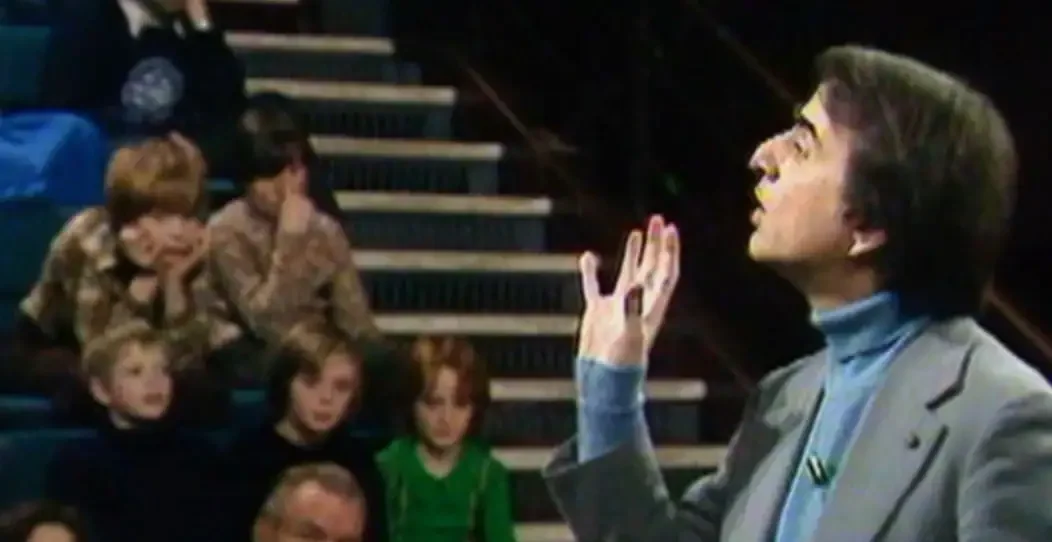
Dr Sagan presenting the 1977 series “The Planets”
If the Christmas Lectures are about wonder plus understanding, then Carl Sagan is one of their most perfect ambassadors.
Sagan presented the 1977 series: “The Planets” — six lectures that brought the solar system to life with the kind of calm authority that makes you sit up straighter without knowing why.
Sagan’s gift wasn’t just knowledge — it was scale. Perspective. Humility.
He had a way of saying, “Look how extraordinary this is” without turning it into a performance. And if you grew up watching him, you didn’t just learn facts — you absorbed a worldview:
Evidence matters
Curiosity is noble
And the universe is far too interesting to waste your attention
Even now, the Royal Institution continues to highlight Sagan’s lectures as part of its recorded archive and online viewing.
You can enjoy Dr Sagan's talks here, and I hope it encourages you to do a deep dive into his work.. You owe it to yourself to discover Cosmos if you have yet to do so:
https://www.youtube.com/watch?v=aAxvxIOwnWM
Notable presenters: a roll-call of serious minds
One of the great joys of the Christmas Lectures is the sheer calibre of people who have taken the stage.
Across the decades, notable names include:
Sir William Bragg and Sir Lawrence Bragg (Nobel-calibre physics)
Sir David Attenborough (yes, that Attenborough — delivering “The Language of Animals”)
Eric Laithwaite (engineering, magnets, and the kind of demonstrations that make your eyebrows rise)
Richard Dawkins (evolutionary biology, delivered with characteristic sharpness)
Baroness Susan Greenfield — the first woman to present the Christmas Lectures in 1994
And the tradition remains alive and contemporary — for example, the Royal Institution’s 2025 lectures are being delivered by Dame Maggie Aderin-Pocock, focusing on space and time on the bicentennial year.
This is part of the legacy: the series keeps renewing itself with modern voices, modern tools, and modern scientific frontiers — while retaining the same core promise to the audience.
The traditions: what makes it feel like Christmas Lectures
You can spot Christmas Lectures DNA a mile off, because it has rituals:
A lecturer who becomes your guide, not your examiner
A live audience, with genuine participation and reactions
Demonstrations that risk going wrong (which, frankly, is half the thrill)
A balance of seriousness and delight
A tone that says: “This is for you — yes, you — and you’re clever enough to understand it.”
And perhaps the most important tradition of all:
It respects young people
It assumes curiosity is natural, and intelligence is not limited by age.
That’s a rare thing on television, then and now.
Why it mattered to me (and why it still does)
I’ve always loved classic British television — the era where you could stumble across something brilliant by accident, usually sandwiched between something cosy and something slightly odd.
But the Christmas Lectures were different. They were a yearly reminder that science wasn’t locked away in universities or laboratories. It was part of life. Part of culture. This young man from the West Wales countryside, from a council estate, had every right to know about the universe as an Oxford don.
For me, they became an annual tradition because they offered something I didn’t get anywhere else in quite the same way:
A chance to see notable scientists and speakers of our time talk about topics they are deeply, inherently skilled in — not summarising them, not “content-ifying” them, but translating them with care.
They were a gateway into science, biology, and technology that might otherwise have been restricted to:
Tomorrow’s World
late-night Open University broadcasts
or the sort of book you borrow from the library and pretend you totally understand
But the Christmas Lectures did it with warmth. With theatre. With a genuine love of explanation. Dare I say, with a touch for flair and style that would make 'Doctor Who' blush.
In my view, that’s their greatest legacy:
They don’t just teach science. They teach the love of learning.
And honestly? In a world that increasingly tries to sell us certainty, that ability to stay curious feels more valuable every year.
As I move into my 54th year, I still have the same passion for knowledge as when I first set eyes on this series... It's for the young and young at heart with a thirst for learning.
The legacy: Britain’s most elegant science outreach engine
If you measure impact not just by ratings, but by influence, the Christmas Lectures sit in a class of their own.
For two centuries, they’ve:
inspired careers
normalised scientific thinking in mainstream culture
and proven that “educational” doesn’t need to mean “dry”
They’re not just a programme. They’re a cultural bridge: from Faraday’s candle… to the modern world of genetics, AI, climate science, space telescopes, and beyond.
And for those of us who’ve made it a tradition: they’re a yearly invitation to feel that childhood spark again — except now, with better snacks and a slightly louder sigh when we stand up from the sofa.
If you grew up watching them, who was your lecturer?
Was it Sagan? Attenborough? Greenfield? Someone else entirely?
I’d genuinely love to hear which series stuck with you — and why.
I would like to thank you for your support this year.
If you have read any of my articles and found them interesting, please let me know.
Have a wonderful Christmas and New Year! Ho Ho Ho!
#RoyalInstitution hashtag#ChristmasLectures hashtag#ScienceCommunication hashtag#STEM hashtag#ScienceEducation hashtag#CarlSagan hashtag#BritishTelevision hashtag#PublicEngagement hashtag#Curiosity hashtag#LifelongLearning hashtag#ScienceForAll hashtag#FutureOfScience hashtag#Inspiration hashtag#UKScience
