

The Arena Has Changed — But the Struggle Has Not.. Wisdom From The Past - A Welsh View of an American Hero
The Man In The Arena - Speech at the Sorbonne - Paris, France April 23, 1910
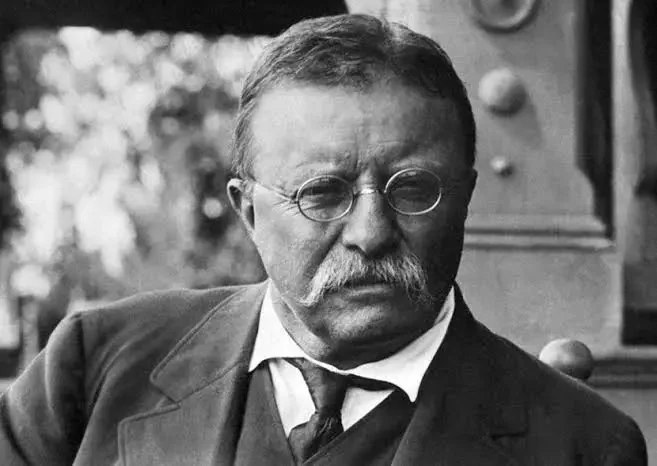
Theodore Roosevelt - October 27, 1858 – January 6, 1919 - A wise hero
"It is not the critic who counts; not the man who points out how the strong man stumbles, or where the doer of deeds could have done them better. The credit belongs to the man who is actually in the arena, whose face is marred by dust and sweat and blood; who strives valiantly; who errs, who comes short again and again, because there is no effort without error and shortcoming; but who does actually strive to do the deeds; who knows great enthusiasms, the great devotions; who spends himself in a worthy cause; who at the best knows in the end the triumph of high achievement, and who at the worst, if he fails, at least fails while daring greatly, so that his place shall never be with those cold and timid souls who neither know victory nor defeat."
I had these words stuck to the inside of my wardrobe throughout my late teens, my college life, and forever since I have had these words close by. As I was born on July 4th, I have always felt an affinity for the United States of America.
Why would this excerpt by the late president be important to me, so much so that it's been a touchstone for nearly 40 years?
I am very open about my mental health journey, my anxieties, my doubts, my neurosis. I find these words comforting. At my worst, I haven't wanted to leave the house. At my best, at my worst, I simply wanted to give up and walk away.
The successes I have achieved in life, both career and personal, have been through being bold, taking chances, not accepting the status quo, and saying yes when my odds were not in my favour, and the anxiety was often overwhelming. If anything, use whatever skills I have developed over the years to even the odds.
Every so often, I look at these words and have done so again this weekend. I looked at them originally through the eyes of a 17-year-old, and now, as a 53-year-old man, I am not only looking at them just through my eyes but also the eyes of my 27-year-old son, and I am writing this article for him.
The modern man does not face the same battlefield as Roosevelt’s generation. There are no cavalry charges or frontier expansions. Instead, the arena is quieter—but no less brutal.
It is:
The uncertainty of careers reshaped by AI and automation
The pressure to provide amid rising costs and economic instability
The expectation to be emotionally aware, yet stoic
The noise of politics, division, and constant digital scrutiny
The quiet burden of responsibility—to family, to self, to purpose
In short, today’s arena is internal as much as external.
And here is where Roosevelt’s words cut sharply:
It is not the observer who counts. It is the one who shows up.
The Welsh Lens — Grit, Hiraeth, and Quiet Endurance
To understand this message more deeply, one might look not to Paris, but to Wales.
Across the valleys and mountains—from Pen y Fan to the old coal communities—there exists a cultural memory of endurance.
Men who worked in darkness, who carried weight not just physically but emotionally. Men who did not always have the language for struggle—but lived it nonetheless.
There is a word in Welsh:
Hiraeth. A longing. A pull toward something deeper—home, identity, meaning.
Modern men often feel this without naming it:
A sense that something is missing
A desire to be more grounded, more purposeful
A tension between who they are and whom they feel they should be
Roosevelt’s “arena” speaks directly into this space.
It tells us that meaning is not found in ease, but in engagement.
Mindfulness — The Modern Armour
Here is where the ancient and the modern meet.
Mindfulness, often misunderstood as passive calm, is in fact a form of active presence.
It is the discipline of standing in your own arena—fully aware, without retreat.
To be mindful is:
Accept uncertainty without paralysis
Observe criticism without being defined by it
Continue forward despite imperfection (almost living through Agile principles, if you're familiar with them.. good enough.. iteratively develop)
Roosevelt describes a man “marred by dust and sweat and blood.”
Today, that might look like:
A man who keeps going despite setbacks at work
A father navigating pressures he cannot always articulate
Someone rebuilding after failure, quietly and without applause
Mindfulness does not remove struggle. It anchors you within it.
The Tyranny of the Critic — Then and Now
In Roosevelt’s time, critics stood on the sidelines. Today, they live in our pockets.
Social media has amplified the “cold and timid souls” he warned of:
Anonymous judgement
Performative outrage
Endless comparison
The modern danger is not just external criticism, but internalised criticism.
Men measuring themselves against impossible standards, curated lives, and shifting expectations. Indeed, 'toxic' masculinity. Journalist Louis Theroux recently did a documentary about this very thing, and Tom Cruise famously parodied it in the classic Paul Thomas Anderson 1999 film Magnolia.
Ironically, it's been nearly 27 years since that, as long as my son has been alive, and it's no better. Indeed, it's gotten far worse.
Roosevelt’s rebuttal is timeless: The critic does not count. The effort does.
Failure, Courage, and the Redefinition of Strength
One of the most radical aspects of the speech is its view of failure.
Failure is not shameful. Failure is evidence of participation.
In many ways, this challenges traditional notions of masculinity:
Strength is not dominance—it is resilience
Success is not perfection—it is persistence
Courage is not certainty—it is action despite doubt
Through a Welsh lens, this echoes the quiet strength seen in communities that endure hardship without spectacle. Strength not as noise—but as continuity.
I had a curry with a group of my close childhood friends recently for a reunion, all successful men in their own lives. We inevitably talked about our careers, family, and the journey we have been on. All making do, some making 'more' than just do.
What they told me blew me away, as many of them:
Never written a CV or a resume
Hardly use a computer
Never attended higher education
Rarely, if ever, interact with Socials and have only heard about LinkedIn in passing
Practical Takeaways for the Modern Man
Let us bring Roosevelt’s philosophy into something tangible:
1. Show Up — Especially When It’s Difficult
Consistency is the modern form of courage. Whether in career, health, or relationships, presence matters more than perfection. For God's sake, just turn up. I often talk about my recent gym attendance for my Gower Walk. The hardest part is not the physical exercise but simply turning up at the gym.
2. Redefine Failure
Every setback is proof that you are in the arena. The only true failure is withdrawal.
3. Guard Your Mind
Be selective about what voices you allow to matter. Not all criticism is equal—and most of it is irrelevant. Criticism is important, but how you filter it matters. Recognise the difference between genuine feedback and abuse. Challenge the unacceptable and show gratitude for those who genuinely take the time out to support and provide substantive, valid feedback.
We 'all' have our critics. Our careers are often defined by working towards improving perception. Reality is, we can rarely do that. All we can do is be as correct as possible in the moment and address any of our own shortcomings, be consistent, and dependable.
Perception is always filtered by the agenda of the viewer.
If you don't fit that, then you're surplus to requirements.
4. Embrace Hiraeth as Direction, Not Burden
That sense of longing? It is not a weakness. It is a compass pointing toward meaning.
5. Practice Mindfulness Daily
Even briefly:
A walk through nature (the Welsh countryside remains an excellent teacher)
A moment of stillness before reacting - step out of the room/don't answer that TEAMS immediately - Offer to come back with a timescale
Awareness of breath in times of stress
This is not softness. It is discipline.
A Final Thought — The Quiet Heroism of Trying
Roosevelt’s final line lingers:
“…so that his place shall never be with those cold and timid souls who neither know victory nor defeat.”
There is, in that sentence, a quiet defiance.
To live fully—to strive, to fail, to try again—is itself an act of rebellion in a world that often rewards passivity and commentary over action.
So whether one stands in a boardroom in London, walks the coastline of the Gower, or climbs toward the summit of Pen y Fan in wind and rain, the principle remains:
Be in the arena.
Not perfect. Not certain. But present.
#TheManInTheArena #Roosevelt #Leadership #Mindset #Resilience #Courage #PersonalGrowth #Mindfulness #MentalStrength #ModernMasculinity #MensHealth #EmotionalIntelligence #SelfDevelopment #Purpose #Discipline #Consistency #BeBold #TakeChances #GrowthMindset #FailureIsFeedback #KeepGoing #ShowUp #Hiraeth #Wales #Welsh #Grit #Endurance #LifeLessons #Inspiration #LeadershipDevelopment #TheManInTheArena #TheodoreRoosevelt #DaringGreatly #InTheArena #ModernMen #MensWellbeing #MentalResilience #InnerStrength #Stoicism #MindfulLeadership #AuthenticLeadership #Vulnerability #StrengthInStruggle #CareerGrowth #AIImpact #FutureOfWork #Adaptability #Uncertainty #PurposeDriven #LiveWithIntent #SelfMastery #EmotionalResilience #DigitalAge #SocialPressure #StandYourGround #WelshPride #Cymru #Hiraeth #ValleysToSummit #PenYFan #Gower #WalkYourPath #QuietStrength #RealTalk #NoSpectators
