
The BBC Domesday Project: When the Future Became Obsolete
Was it worth the effort?
In 1086, Domesday Book captured a snapshot of England so durable that it still exists nearly a millennium later.
Nine centuries later, the BBC set out to do the same — but using cutting-edge Eighties technology.
The result? A visionary project that became obsolete within just 15 years.
Indeed, Tomorrow's World became yesterday's news.
This is the story of the BBC Domesday Project (1984–1986) — one of the most ambitious digital archives ever created… and one of the earliest warnings about the fragility of digital knowledge.
A new article.
The Vision: A Digital Britain Before the Internet
Launched to mark the 900th anniversary of the original Domesday Book, the BBC’s goal was bold:
Create a complete, interactive, multimedia record of life in the UK — for education, museums, and future generations.
This was not a static archive. It was interactive, searchable, and geographically navigable — decades before Google Maps or Wikipedia.
Over 1 million contributors, including schoolchildren
Thousands of photographs, maps, and videos
Census data, agricultural statistics, and cultural insights
A “virtual walk-through” experience of Britain
In modern terms, this was Wikipedia + Google Earth + YouTube… in 1986.
The Technology: Astonishingly Advanced for Its Time
The Domesday Project was built on a hybrid system that fused computing with video technology.
Core Architecture
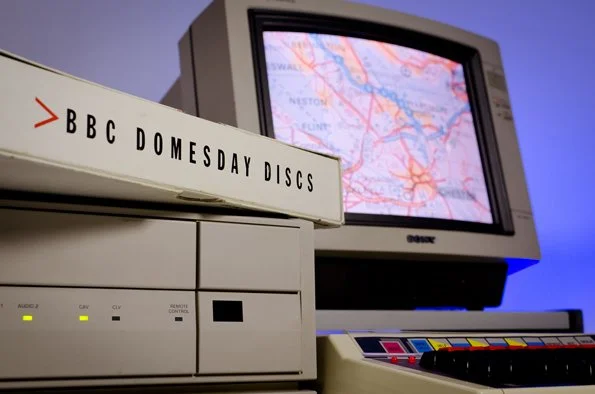
LV-ROM LaserDiscs (LaserVision Read Only Memory)
BBC Master AIV computer (Acorn-based system)
Philips VP415 LaserDisc player
Trackball navigation interface
Each disc could store:
~300MB per side
Up to 80,000 images
Hundreds of thousands of text pages
This was extraordinary at a time when most home computers had kilobytes of memory.
Why LaserDisc?
At first glance, this seems like a strange choice.
But in 1984–86, it was actually the only viable option.
No JPEG compression
No practical digital photo storage
No widely available CD-ROM
Limited computer graphics capability
LaserDisc allowed:
Storage of thousands of still images as analogue video frames
Integration of digital data + video on one medium
In essence, it was an early form of multimedia computing — years ahead of its time.
Interactive Innovation
The system enabled:
Map-based navigation using Ordnance Survey grids
Zooming from national to local levels
Natural language search (primitive but groundbreaking)
Virtual “walkthrough” environments
This wasn’t just storage — it was experience design.
It was frankly borderline science fiction for 1986. The technology had been used for arcade video games such as Dragon's Lair, Firefox, and Astron Belt. In addition to home entertainment with Hollywood blockbusters available on LaserDisc, this was something entirely new.
The Research Model: The First Crowdsourced Database
Perhaps the most remarkable aspect was how the data was gathered.
Schools across the UK contributed local insights
Communities documented their own lives
Regional data was mapped geographically
This has been described as one of the earliest examples of crowdsourced data collection
Decades before:
Wikipedia (2001)
OpenStreetMap (2004)
Social media
The BBC had already mobilised a nation.
The Fatal Flaw: Technological Obsolescence
Despite its brilliance, the Domesday Project suffered from a critical issue:
It was built on cutting-edge technology that aged rapidly.
1. Hardware Dependency
To access the discs, you needed:
A BBC Master AIV computer
A specific LaserDisc player
Special interface hardware
The system cost in 1986 was around £5,000 — limiting adoption - The equivalent today in 2026 of £20,000.
As hardware disappeared, so did access.
2. Format Fragility
The data was stored in a hybrid format:
Analogue video (images)
Digital overlays (text and interface)
This created major preservation challenges:
Difficult to extract cleanly
Hard to emulate
Dependent on synchronised hardware
Even more concerning, the LaserDisc format was prone to disc rot. LaserDisc rot (often called laser rot) is the gradual degradation of the disc’s internal reflective layer, which causes playback errors. The disc literally begins to corrode from within, making the stored video signal unreadable. Unlike scratches or dirt (external issues), this is an internal structural failure — and once it starts, it cannot be reversed.
3. The Rise of Better Alternatives
By the early 1990s:
CD-ROM emerged
PCs became more powerful
Standardised formats replaced bespoke systems
Meanwhile, LaserDisc itself:
Remained niche
Was expensive
Was overtaken by DVD and digital storage
4. The “Digital Dark Age” Problem
By 2002, just 16 years later:
The discs were at risk of becoming unreadable
Compatible machines were rare
Data extraction was extremely difficult
The irony?
The medieval Domesday Book survived 900 years. The digital one nearly vanished in 15.
Rescue Efforts: Saving a Digital Time Capsule
Thankfully, the story doesn’t end there.
Projects like:
CAMiLEON (University of Leeds & Michigan) - https://www.dpconline.org/docs/miscellaneous/events/270-future-r-d-wheatley/file
Domesday86 preservation initiative - https://www.domesday86.com/
Used:
Emulation
Video capture
Data migration
To recover the archive and make it accessible again
But it required:
Reverse engineering
Specialist hardware
Years of effort
A stark reminder of how fragile digital systems can be.
Lessons for Today (And Why This Still Matters)
This project is more than a historical curiosity — it’s a warning.
1. Technology Moves Faster Than Preservation
What is cutting-edge today may be unreadable tomorrow.
2. Proprietary Systems Are Risky
Closed ecosystems can become digital dead ends.
3. Data Without Accessibility Is Useless
If you can’t read it, you don’t own it.
4. The Medium Matters as Much as the Message
Longevity should be a design requirement — not an afterthought.
Final Thought
There's something almost poetic about this:
The BBC set out to build a digital monument to Britain — and instead created one of the first examples of the digital dark age.
Yet in doing so, they also gave us something invaluable:
A blueprint of both what to build — and what to avoid.
The concept was a bold but ultimately flawed initiative, based on technology with built-in (but to be kind, unanticipated) obsolescence, cost-prohibitive to its desired audience, and never surpassed the original concept of a physical manuscript.
...and then the Internet arrived..
#BBC #DomesdayProject #DigitalTransformation #TechnologyHistory #Innovation #DataPreservation #DigitalArchiving #AI #FutureOfWork #InformationManagement #BigData #DigitalHeritage #TechLessons #ITLeadership #DataStrategy #DigitalStrategy #CloudComputing #LegacySystems #TechEvolution #KnowledgeManagement #EdTech #PublicSectorInnovation #UKHistory #DigitalDarkAge #TechnologyLeadership
